AI Writing Assistant: The Complete Guide to Smarter, Faster, Better Writing
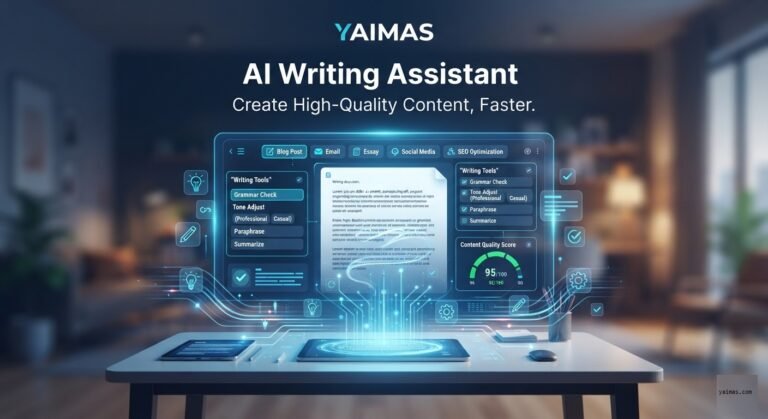
AI Writing Assistant helps you write, rewrite, edit, summarize, and improve content faster. Whether you’re creating blog posts, emails, marketing copy, or everyday content, Yaimas AI Writing Assistant helps you turn your ideas into clear, engaging, and polished writing with the power of AI.
A blank page that once meant hours of research, outlining, drafting, editing, and rewriting can now become the starting point for a much faster creative process. The reason is simple: artificial intelligence has moved from being a futuristic concept to a practical writing companion that people can use every day.
Whether you are a blogger trying to publish consistently, a business owner creating website content, a student organizing ideas, a marketer writing campaigns, or a professional preparing emails and reports, an AI Writing Assistant can help you move from an idea to a polished draft with considerably less friction.
But there is an important distinction.
AI should not replace your thinking, experience, personality, or judgment. The best results happen when you treat AI as a collaborative tool rather than a machine that writes everything for you.
That is where modern AI Writing Tools become especially useful.
They can help you brainstorm topics, develop outlines, improve awkward sentences, summarize information, adjust tone, generate first drafts, rewrite existing copy, and identify areas that need clarification. Used thoughtfully, they can give writers more time to focus on what actually makes content valuable: ideas, originality, expertise, storytelling, and connection with the reader.
This guide explains what an AI Writing Assistant is, how AI writing software works, what you can accomplish with it, where free tools fit into the picture, and how to use AI responsibly without turning your content into generic machine-written copy.
An AI Writing Assistant is a software application that uses artificial intelligence to help people create, improve, organize, or edit written content.
Instead of simply checking spelling and grammar, modern AI writing systems can work with natural-language instructions. You can give the tool a topic, question, rough paragraph, set of notes, or specific writing goal, and it can help transform that input into a more organized piece of writing.
For example, you might provide a rough idea such as:
“I need to explain why small businesses should have a blog.”
An AI writing assistant could help you turn that idea into:
- A list of possible article angles
- A content outline
- Potential headlines
- An introduction
- Key arguments
- Frequently asked questions
- A conclusion
- Social media variations
- Email copy
- Editing suggestions
The important part is that the writer remains responsible for deciding what deserves to be published.
Think of an AI writing assistant as a combination of brainstorming partner, editor, research organizer, and drafting assistant.
It can accelerate the writing process, but your knowledge and judgment give the final content its value.
Why Are AI Writing Tools Becoming So Popular?
The actual act of typing sentences is often only one part of the process. Before publishing a 2,000-word article, for example, a writer may need to understand the topic, identify the audience, research competing viewpoints, create an outline, decide on a structure, write the first draft, revise it, proofread it, optimize headings, create metadata, and prepare promotional copy.
That process can take hours.
AI Writing Tools help reduce the amount of time spent on repetitive tasks.
They are particularly attractive to people who produce content regularly because even small time savings can become significant over weeks and months.
A marketer who spends 30 minutes creating an initial campaign draft instead of two hours can use the extra time for strategy. A blogger who spends less time fighting with an introduction can focus more heavily on research and storytelling. A business owner can create a first version of a product description without waiting days for a copywriting resource.
The technology is useful because it addresses one of the biggest problems in modern content creation:
The demand for content is often much higher than the time available to create it
How Does an AI Writing Assistant Work?
These systems are trained to recognize patterns in language and generate text based on the instructions and context they receive. When you provide a prompt, the system analyzes the words, context, and requested task before generating a response.
That sounds complicated, but using one can be remarkably simple.
You might type:
“Rewrite this paragraph for a small-business audience using a friendly and professional tone.”
The assistant then attempts to produce a version that follows those instructions.
The quality of the output depends heavily on the quality of the instructions.
A vague request such as:
“Write about marketing.”
usually produces a broad response.
A more specific instruction such as:
“Write a 150-word introduction for U.S. small-business owners explaining how email marketing can help increase repeat purchases. Use a practical, conversational tone and avoid exaggerated claims.”
gives the system much more useful direction.
This is why learning how to communicate with AI is becoming an important writing skill
Why Are AI Writing Tools Becoming So Popular?
1. Brainstorming Ideas
Coming up with the right topic can sometimes be harder than writing the article itself.
An AI assistant can generate potential topics based on your audience, industry, product, or objective.
For example, a fitness website could brainstorm:
- Beginner workout topics
- Home exercise guides
- Nutrition questions
- Equipment comparisons
- Training mistakes
- Recovery advice
- Seasonal fitness content
The writer can then evaluate those ideas and choose the ones that genuinely provide value.
2. Creating Outlines
A strong outline can make long-form writing dramatically easier.
Instead of staring at an empty document, you have a logical structure to work from.
An AI assistant can suggest:
- Main headings
- Subheadings
- Supporting points
- Frequently asked questions
- Possible examples
- Logical transitions
You do not have to accept the outline exactly as generated. Treat it as a starting framework.
3. Drafting Content
This is probably the most obvious use.
AI can generate an initial draft based on a topic and set of instructions.
However, the first draft should usually be treated as raw material rather than a finished article.
A good writer will review the content for accuracy, add original examples, remove generic statements, introduce personal expertise, improve transitions, and make the piece sound like the brand.
4. Rewriting Existing Content
Sometimes you already have good information but the writing needs improvement.
An AI writing assistant can help make text:
- Clearer
- Shorter
- More conversational
- More professional
- More persuasive
- Easier to understand
- Better organized
This can be particularly helpful when you’re editing old website pages.
5. Improving Grammar and Clarity
Writers often become too close to their own work.
After reading the same paragraph several times, it becomes difficult to notice awkward wording.
AI can act as an additional editing layer by identifying sentences that may be confusing, repetitive, overly long, or unnecessarily complicated.
6. Changing the Tone
The same information may need to sound different depending on the audience.
A professional report, social media post, product page, and customer email shouldn’t necessarily have the same voice.
An AI assistant can help transform content into styles such as:
- Friendly
- Professional
- Conversational
- Educational
- Persuasive
- Concise
- Enthusiastic
- Formal
The final choice should still match your brand guidelines.
Free AI Writing Tools: Are They Worth Using?
One of the most common searches around this technology is Free AI Writing Tools.
And there is a good reason.
Not everyone wants to pay for a subscription before understanding whether AI writing technology is actually useful for them.
Free plans can be a practical way to experiment with AI-assisted writing.
Depending on the platform, a free tool may allow users to perform tasks such as brainstorming, rewriting, summarizing, drafting short content, or generating basic ideas.
However, free does not necessarily mean unlimited.
Many free AI writing tools place restrictions on:
- Number of generations
- Daily usage
- Available models
- Word limits
- Advanced features
- File uploads
- Collaboration
- Brand controls
- Specialized writing functions
For someone who writes occasionally, a free plan may be more than enough.
For a professional content team producing large amounts of material, a paid solution may provide better value.
The smartest approach is not to ask, “Is this tool free?”
Instead, ask:
“Does this tool solve my writing problem well enough to justify its cost?”
AI Writing Assistant Free: What Should You Expect?
People searching for AI Writing Assistant Free options are often looking for a tool that can help with everyday writing without requiring a subscription.
That is a reasonable place to start.
A free AI writing assistant can be useful for simple tasks such as:
- Generating article ideas
- Creating rough outlines
- Rewriting sentences
- Summarizing notes
- Improving readability
- Drafting simple emails
- Creating headline variations
- Brainstorming content
- Expanding short ideas
But you should understand the limitations.
Free tools may provide fewer features, lower usage limits, or less control than premium software. Some may also restrict access to more advanced models or workflow features.
Before choosing one, consider what you actually need.
If your primary requirement is occasional brainstorming, a basic free assistant could be sufficient.
If you’re managing a content operation with dozens of articles, product pages, email campaigns, and marketing assets every month, more advanced software may save enough time to justify the investment.
AI Tools for Writing: Which Tasks Benefit Most?
The phrase AI Tools for Writing covers a much broader category than article generation.
Different tools can support different stages of the writing process.
Content Ideation
AI can quickly generate potential topics based on an audience or niche.
Research Organization
AI can help organize information you’ve already collected and turn scattered notes into a logical structure.
First Draft Creation
A tool can transform an outline into a rough first draft.
Editing
AI can identify awkward sentences, repetition, and clarity problems.
Content Repurposing
A long article can become:
- Social posts
- Email newsletters
- Video scripts
- Short summaries
- FAQs
- LinkedIn posts
- Content snippets
Personalization
AI can help create variations of the same message for different customer segments.
SEO Content Planning
AI can help organize keyword themes, search-intent questions, heading ideas, and content gaps.
But SEO is not simply about inserting keywords into an article.
The best search-focused content answers the user’s question thoroughly and naturally.
AI Writing Software vs. Traditional Writing
It is tempting to frame AI and human writing as competing approaches.
That comparison isn’t particularly useful.
The more practical question is:
How can AI and human writers work together effectively?
Traditional writing gives you human experience, judgment, creativity, context, and emotional understanding.
AI provides speed, scale, pattern recognition, and assistance with repetitive tasks.
Combining those strengths can create a more efficient workflow.
For example, a writer might spend 20 minutes brainstorming with AI, 30 minutes researching the subject, 45 minutes drafting, and another hour editing and adding original insight.
Without AI assistance, the brainstorming and initial drafting stages might take considerably longer.
The goal isn’t to eliminate the writer.
The goal is to reduce unnecessary friction.
The Biggest Mistake People Make With AI Writing Software
The biggest mistake is assuming that generating text is the same thing as creating good content.
It isn’t.
AI can produce grammatically correct paragraphs that say very little.
It can create introductions that sound impressive but contain no useful information.
It can repeat common opinions.
It can make broad claims without enough context.
It can also produce information that requires verification.
That means pressing a button and publishing the output is rarely the best content strategy.
A better process is:
AI generates possibilities. You provide judgment.
That difference matters.
How to Make AI-Assisted Content Sound Human
If you want your content to feel authentic, don’t simply ask an AI tool to “make it human.”
Instead, give the content actual human input.
Add Experience
Include examples based on real situations.
Instead of:
“Businesses should create valuable content for their customers.”
Try:
“When a customer asks the same question three times, that question may deserve its own article.”
The second version feels more practical because it reflects an observable business situation.
Add Opinions
Generic content often avoids taking a position.
Human writers can explain what they believe works and why.
Add Specific Examples
Specificity creates credibility.
Instead of saying:
“AI can save time.”
Explain what the time is being saved on.
Remove Repetition
AI-generated drafts can sometimes repeat the same idea in slightly different language.
Edit aggressively.
Use Natural Transitions
People don’t always write with perfectly symmetrical sections.
A little variation makes content feel more natural.
Keep Your Brand Voice
If your company is friendly and direct, don’t publish content that suddenly sounds like a corporate textbook.
Your voice should remain recognizable.
How to Use an AI Writing Assistant for SEO
SEO has changed considerably.
Search engines are increasingly focused on whether content genuinely satisfies the user’s intent rather than simply matching a keyword repeatedly.
That makes AI useful for SEO planning, but dangerous when used as a shortcut.
For example, suppose your primary keyword is:
AI Writing Assistant
Related terms might include:
- AI Writing Tools
- Free AI Writing Tools
- AI Writing Assistant Free
- AI Tools for Writing
- AI Writing Software
A weak strategy would be to force each phrase into every section.
A better strategy is to understand the relationship between the terms.
The primary keyword describes the central topic.
The supporting keywords represent related searches and user needs.
That allows you to create a comprehensive article rather than a keyword-stuffed page.
Match Content to Search Intent
Someone searching for “AI Writing Assistant” may be researching the category.
Someone searching for “AI Writing Assistant Free” may be actively looking for a free solution.
Someone searching for “AI Writing Software” may be comparing platforms.
Those users have different expectations.
A good SEO article recognizes those differences.
Should You Use AI to Write Every Blog Post?
Not necessarily.
AI can be extremely useful, but there are situations where human-led writing is particularly important.
For highly personal content, first-hand experiences, expert commentary, sensitive subjects, and stories that depend heavily on individual perspective, the human contribution should be substantial.
AI works best when it supports the writer rather than becoming the writer.
A practical workflow might look like this:
Step 1: Define the audience.
Know who you’re writing for.
Step 2: Define the search intent.
Understand what the reader actually wants.
Step 3: Research the subject.
Collect trustworthy information.
Step 4: Build the outline.
Use AI if it helps, but adjust the structure yourself.
Step 5: Create the draft.
Let AI accelerate the initial writing process where appropriate.
Step 6: Add expertise.
Include examples, insights, experiences, and opinions.
Step 7: Fact-check.
Verify claims, statistics, names, dates, and technical information.
Step 8: Edit for voice.
Make the article sound like your brand.
Step 9: Optimize for search.
Improve headings, keyword relevance, internal links, metadata, and readability.
Step 10: Publish only after human review.
This final step is essential.
How AI Can Help Bloggers
Bloggers often face one major challenge:
Consistency.
You may have dozens of ideas but struggle to turn them into finished articles.
An AI writing assistant can help break the process into smaller tasks.
For example, you could start with a simple idea:
“Ways freelancers can find better clients.”
From there, AI can help you create a structure covering:
- Why client quality matters
- Where freelancers find clients
- How to evaluate prospects
- Warning signs of bad clients
- Pricing conversations
- Building long-term relationships
- Referral strategies
The writer can then add personal knowledge and examples.
This approach is often much easier than attempting to produce 2,500 words from a blank screen.
How AI Can Help Small Businesses
Small businesses frequently operate with limited resources.
The owner may be responsible for sales, customer service, operations, social media, and marketing at the same time.
Writing can become another task competing for attention.
AI tools can assist with:
- Website copy
- Product descriptions
- Email campaigns
- Customer responses
- Blog articles
- Social media content
- Ad variations
- Promotional materials
- Internal documentation
This doesn’t mean every piece should be automatically generated.
Instead, AI can give small teams a faster starting point.
A business owner can provide the facts and approve the final message while AI helps with structure and wording.
How Marketers Use AI Writing Tools
Marketing departments produce an enormous variety of written content.
A single campaign may require:
- Landing page copy
- Email subject lines
- Email body copy
- Social media posts
- Ad variations
- Product descriptions
- Blog content
- Video scripts
Creating each version from scratch can take significant time.
AI writing tools can help marketers adapt one core idea across different formats.
For example, a product announcement could become:
One landing-page section.
Three email subject lines.
A customer email.
Five social media posts.
A short video script.
A FAQ entry.
The marketing team still needs to determine the message and verify the claims, but AI can speed up the transformation process
AI Writing Tools for Students
Students can also use AI writing technology, but responsible use is important.
AI can be helpful for:
- Brainstorming research questions
- Understanding difficult concepts
- Creating study outlines
- Improving grammar
- Generating practice questions
- Organizing notes
- Explaining complex ideas in simpler language
However, students should follow their school’s policies regarding AI.
Using AI to understand a topic is very different from submitting generated work as one’s own when that violates academic rules.
The best educational use is often to make the student a better thinker and writer rather than simply producing an assignment for them.
AI Writing for Emails
Email is one of the easiest areas where AI can save time.
A short instruction can transform a rough thought into a professional message.
For example:
“I need to tell a customer that their order is delayed by two days. Apologize, explain the situation clearly, and offer a helpful next step.”
The assistant can create a first version.
You can then adjust the details and make the tone appropriate for your business.
This is particularly useful for people who know what they want to say but struggle with wording.
AI Writing for Social Media
Social media requires consistency, but constantly coming up with new ideas can become exhausting.
AI can help turn one topic into multiple content angles.
For example, an article about productivity could produce:
- A short tip
- A question
- A myth-versus-fact post
- A checklist
- A personal-story prompt
- A statistic-based post
- A short educational thread
The key is to avoid publishing generic content simply because it was easy to generate.
Social media works best when content reflects a recognizable point of view
AI Writing for E-Commerce
E-commerce businesses have another practical use for AI.
Large stores may have hundreds or thousands of products, each requiring descriptions.
AI can help create initial versions based on product specifications.
For example, given accurate information about a product, an AI tool can organize:
- Product features
- Benefits
- Use cases
- Short descriptions
- Longer descriptions
- FAQs
- Comparison points
Human review remains essential because inaccurate product information can damage customer trust and create unnecessary returns.
.
Can AI Writing Tools Replace Professional Writers?
For most organizations, the more useful question isn’t whether AI can technically generate text.
It can.
The question is whether generated text can consistently replace the strategic, editorial, creative, and subject-matter expertise of a professional writer.
In many situations, that is a much harder problem.
Professional writers do more than produce sentences.
They determine:
- What should be said
- What should be removed
- Who needs to hear it
- Which argument is strongest
- What information is missing
- How a story should be structured
- What tone is appropriate
- Whether a claim is credible
- How content supports a broader business goal
Those skills remain valuable.
AI is more likely to change the writer’s workflow than eliminate the need for good writers.
The Advantages of AI Writing Software
There are several practical benefits.
Faster First Drafts
Getting something on the page can be easier with AI assistance.
Better Productivity
Writers can spend less time on repetitive tasks.
More Ideas
AI can generate alternatives when you’re stuck.
Easier Repurposing
One piece of content can be adapted into multiple formats.
Improved Editing
AI can identify potential clarity and grammar issues.
Greater Accessibility
People who struggle with writing can use AI to communicate ideas more effectively.
Scalable Content Workflows
Teams can create and organize more content without increasing every manual step.
The Limitations of AI Writing Tools
AI isn’t perfect.
It Can Make Mistakes
Generated information should be checked.
It Can Sound Generic
Without strong direction and editing, content may lack personality.
It Doesn’t Automatically Understand Your Business
You still need to provide context.
It Can Repeat Common Ideas
Original thinking must come from the writer and the research.
It Doesn’t Replace Expertise
A generated answer isn’t automatically an expert answer.
Privacy Matters
Don’t blindly enter confidential business information, private customer data, passwords, or sensitive documents into an AI platform without understanding its data policies and organizational requirements
How to Choose the Right AI Writing Assistant
With so many platforms available, choosing one can feel overwhelming.
Start with your actual use case.
For Bloggers
Look for:
- Long-form drafting
- Outlining
- Rewriting
- Content organization
- SEO workflow support
For Businesses
Look for:
- Brand voice controls
- Team collaboration
- Templates
- Document support
- Security and administrative controls
For Students
Look for:
- Explanations
- Summaries
- Brainstorming
- Editing
- Study assistance
For Marketers
Look for:
- Content repurposing
- Campaign workflows
- Multiple content formats
- Collaboration
- Brand consistency
For Occasional Users
A free tool may be enough.
There is no reason to pay for advanced software if you only need help rewriting a paragraph once or twice a month.
Free vs. Paid AI Writing Tools
The choice between free and paid software depends on frequency, complexity, and required features.
Feature | Free AI Writing Tools | Paid AI Writing Software |
Basic writing assistance | Usually available | Available |
Brainstorming | Usually available | Available |
Rewriting | Often available | Available |
Usage limits | More common | Usually higher |
Advanced features | Limited on some platforms | More likely |
Team features | Often limited | More common |
Brand controls | May be limited | More common |
Best for | Casual users | Professionals and teams |
The important thing is not to buy software simply because it has more features.
Choose based on the work you actually perform
A Simple AI Writing Workflow for Beginners
If you’ve never used an AI writing assistant, start small.
Step 1: Pick One Task
Don’t try to automate your entire writing process.
Start with something simple, such as brainstorming.
Step 2: Give Context
Explain who the audience is and what you’re trying to accomplish.
Step 3: Give Clear Instructions
Tell the assistant what format, tone, length, and purpose you want.
Step 4: Review the Output
Don’t assume the first response is the best response.
Step 5: Add Your Own Perspective
Include information the AI doesn’t know.
Step 6: Edit
Remove anything generic, repetitive, inaccurate, or unnecessary.
Step 7: Fact-Check
Verify important claims before publishing.
Step 8: Improve the Final Draft
Your goal isn’t to preserve the AI output.
Your goal is to produce the strongest possible content.
Examples of Better AI Prompts
A strong prompt doesn’t need to be complicated.
Instead of:
“Write a blog about email marketing.”
Try:
“Create a practical outline for a blog aimed at U.S. small-business owners who want to improve email marketing. Cover list building, subject lines, segmentation, automation, common mistakes, and measurement. Keep the structure beginner-friendly and avoid exaggerated claims.”
For editing:
“Rewrite this paragraph for clarity while keeping the original meaning. Use short sentences, a professional but conversational tone, and avoid marketing clichés.”
For brainstorming:
“Give me 15 article ideas for first-time homeowners. Focus on practical questions they are likely to search for before making expensive home decisions.”
Better context generally leads to more useful results.
How to Avoid Generic AI Content
One of the easiest ways to improve AI-assisted content is to make it more specific.
Compare these two statements:
“Good content should provide value to readers.”
That is true, but generic.
Now consider:
“If a reader can finish your article without knowing what to do next, the article probably needs more practical guidance.”
The second statement gives the reader something to think about.
Specificity makes content stronger.
Use:
- Real scenarios
- Concrete examples
- Original observations
- Industry terminology
- Practical recommendations
- Relevant data
- First-hand experience
- Clear opinions
The more genuine information you contribute, the less interchangeable the article becomes.
Does Using an AI Writing Assistant Hurt SEO?
Using AI itself is not the most useful way to evaluate content quality.
The real issue is whether the published page is useful, accurate, original, relevant to the query, and created for the reader rather than solely to manipulate search rankings.
If you use AI to generate hundreds of low-quality pages with little editorial oversight, you’re creating a content problem.
If you use AI to help research ideas, structure information, improve readability, and accelerate drafting while maintaining strong human editorial control, the workflow can be much more useful.
SEO success doesn’t come from pressing an “AI generate” button.
It comes from producing something people actually want to read.
How to Make Your AI-Assisted Blog More Valuable
Before publishing, ask yourself:
Does this article answer the main question?
If not, improve the introduction and structure.
Does it provide information the reader can act on?
Add examples and practical advice.
Does it contain original insight?
Add your own experience and perspective.
Are important claims accurate?
Verify them.
Does the article repeat itself?
Cut unnecessary sections.
Does it sound like your brand?
Edit the voice.
Would you recommend this article to someone you know?
If not, keep improving it.
These questions are more valuable than obsessing over whether every paragraph contains a target keyword.
The Future of AI Writing
AI-assisted writing will likely become increasingly integrated into everyday software.
Instead of opening a separate AI application, people may encounter writing assistance directly inside:
- Word processors
- Email applications
- Website builders
- Marketing platforms
- Customer support systems
- Project-management software
- Note-taking applications
- Content-management systems
The bigger shift may not be “AI writes everything.”
It may be that writing becomes more interactive.
A writer could create an outline, receive suggestions, ask for alternative approaches, test different tones, and improve a draft while staying inside the same workflow.
That makes writing less about starting from nothing and more about directing, evaluating, and refining ideas.
Why Human Creativity Still Matters
Technology can generate words.
But words alone don’t create meaningful communication.
A memorable article often contains something deeper:
A useful observation.
A surprising example.
A personal story.
A strong opinion.
A clear explanation.
A new way of looking at a familiar problem.
These qualities come from understanding people and the world around them.
AI can help you explore possibilities, but creativity still benefits enormously from human curiosity.
The strongest future writers may not be those who refuse AI.
They may be those who know when to use it, when not to use it, and how to turn its output into something genuinely useful.
Frequently Asked Questions About AI Writing Assistants
What is an AI Writing Assistant?
An AI Writing Assistant is software that uses artificial intelligence to help with writing-related tasks such as brainstorming, drafting, rewriting, editing, summarizing, outlining, and improving clarity.
Are Free AI Writing Tools good enough?
For many casual writing tasks, free AI writing tools can be useful. However, free plans often have usage limits or fewer advanced features than paid software. The right choice depends on how frequently you write and what features you need.
What can an AI Writing Assistant Free tool do?
A free AI writing assistant may help with brainstorming, basic drafting, rewriting, summarization, editing, and other everyday writing tasks. Available features vary by platform.
Are AI Tools for Writing useful for bloggers?
Yes. Bloggers can use AI tools for writing to brainstorm topics, create outlines, develop first drafts, rewrite sections, generate headlines, and repurpose published content
Can AI Writing Software write a complete article?
Many AI writing software platforms can generate complete drafts. However, a generated draft should generally be reviewed, fact-checked, edited, and improved before publication.
Will AI replace writers?
AI is changing how writing is produced, but professional writing involves much more than generating sentences. Strategy, expertise, storytelling, judgment, research, and editorial decision-making remain important.
How can I make AI-generated content sound more natural?
Add your own examples, experiences, opinions, brand voice, and expertise. Remove repetitive or generic statements and edit the draft carefully instead of publishing the first generated version.
Are AI Writing Tools useful for SEO?
They can assist with brainstorming, content organization, keyword planning, outlines, editing, and content production. However, SEO performance depends on overall content quality, relevance, usefulness, technical SEO, authority, and many other factors.
Should I start with a free AI writing assistant?
If you’re new to AI writing, starting with a free option can be a sensible way to understand how the technology fits into your workflow before investing in premium software.
Final Thoughts: Use AI to Write Better, Not Just Faster
The biggest opportunity offered by an AI Writing Assistant isn’t simply the ability to generate more words.
It’s the ability to remove some of the friction between having an idea and communicating that idea effectively.
Whether you explore Free AI Writing Tools, compare different AI Writing Tools, experiment with an AI Writing Assistant Free option, or eventually invest in professional AI Writing Software, the technology is most valuable when it supports a thoughtful writing process.
Use AI for the repetitive parts.
Use it when you’re stuck.
Use it to explore possibilities.
Use it to reorganize information.
Use it as an editor.
But don’t outsource your judgment.
Your experience, perspective, creativity, and understanding of your audience are what turn an ordinary draft into valuable content.
The future of writing doesn’t have to be humans versus AI.
It can be humans using AI intelligently.
And for writers who learn how to combine technology with genuine expertise, that can mean faster workflows, better ideas, and more time to focus on the work that matters.
.